Artificial Baits
Baby Brush Hogs
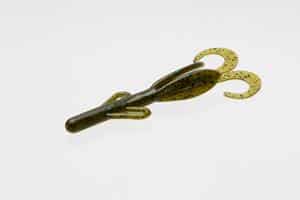
A brush hog works especially well during the spring because it imitates a lizard or some other type of intruder that is attempting to steal eggs.
This bait falls slowly because of its wing-like features on the side.
Combined with a double tail on the back, this bait puts lots of vibration out and can call fish even in murky water.
This soft plastic creature bait features wing-like appendages on the sides that help to slow its descent in the water, suspending it for a strike.
Its double-tail design creates more vibration that draws fish out in low visibility.
They are available in different sizes and colors.
Buzz Baits
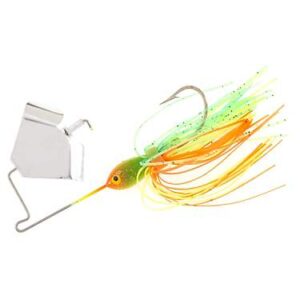
A basic buzz bait will simply spin the blade on the top of the water making a slight trail behind it and a slight noise as it moves.
A buzz bait with holes in the blade will leave a bubble trail that mimics thrashing bait and gives it a unique noise on the surface of the water.
An arm with a clacker will give the buzz bait a louder noise under the water while also adding a slight flash in the right light.
The final buzz bait blade has the blade slightly touching the head of the bait as it spins. This will give the lure a loud vibration under the water and make the bass go crazy.
When fishing in clear water, use white. White will imitate the bottom of almost every different bait, frog, lizard, or even mouse, that bass would come across on the top of the water.
For dark water, always go with black.
How to fish a buzz bait like a pro
Cast out with confidence, and start a speedy retrieve as soon as your buzz bait hits the water.
Docks and other covers are always a successful spot to use your buzz bait.
White and silver: If you see shad in your lake, or know that it’s prime time for bass to target them, then using a white or silver blade is the best choice.
Black and white: While largemouth bass prefer other colors, species such as smallmouth or spotted bass tend to prefer black and white baits.
Gold and black: When the weather is overcast or you’re fishing in low-light conditions, gold and black colored buzzer blades are easiest for the bass to spot.
Chatterbaits
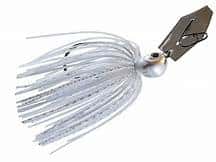
This bait vibrates in the water more than other bait to make big fish take notice.
How to Rig a Chatterbait
Most chatter baits can be purchased pre-rigged which saves you quite a bit of time.
Simply add your soft plastic trailer to the rig to build it up and keep it moving.
One of the most common color ranges is the dark blue or black combination.
The green pumpkin color works throughout all seasons and in most types of water where natural-colored lures are vital.
If you’re fishing in an area where crawfish are a common prey item, use red or coral-colored chatter.
Lakes that have a large number of shad and minnow baitfish would do well in pearl or silver colorations.
Crankbaits
It’s always good to select a model that looks like a natural baitfish, shad, crawfish, etc.
First, choose a natural color with clear water.
Choose the bright colors crankbaits in murky water or off-colored water.
Quick Navigation to Size of Lure
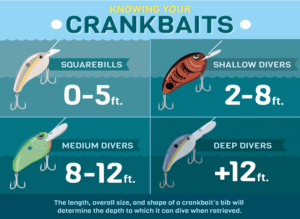
Crankbaits can run from just barely below the surface to as deep as thirty-five feet.
They all use water resistance to make them wobble from side to side.
The most significant difference between crankbaits is the size, shape, and angle of the lip. Or if the crankbait even has a lip.
The length of the bill on the crankbait determines how deep it will dive.
The shallow diving crankbaits are typically 2 to 4 feet in depth.
The medium diving crankbaits range from 6 to 10 feet in depth.
The deep-diving crankbaits can range from 10 feet to 25 feet in depth.
The lure diving depths can be different based on a square bill or conventional round bill.
Lipped versus Lipless
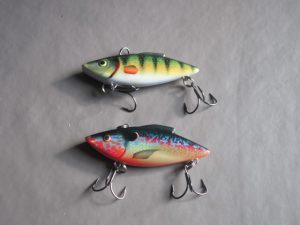
The lipless crankbait has no bill or no lips.
The majority of lipless contain loud rattling sounds, which imitate a school of shad.
Lipless crankbaits are manufactured in sizes between 1/4oz and 2 oz. They’re good to fish with either 2 feet or 50 feet of water.
They produce wobbly or vibrating action when cranked.
What Color Crankbait to Use?
Silvers and whites that resemble a shad work wonder when it comes to a square bill crankbait.
Bright shad patterns like white excel in clear and dirty water, and the more translucent shades are best.
Curly tail Grub
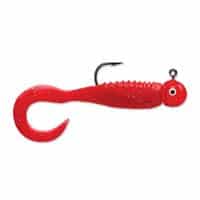
How to Use a Curly Tail Grub
There are primarily two methods of retrieving a jig with a curly tail grub: swimming and jigging.
Swimming is very simple and entails a slow and steady turn of the reel handle with the rod tip low.
Jigging takes on two forms: cast-and-lift and dropping vertically.
After casting, let a jig fall to the bottom and then lift your rod tip to hop the jig off the bottom and slightly toward you while also retrieving the slackline.
Keep repeating as the lure returns to you. Vary jigging action and speed.
A curly tail grub can look like a baitfish OR a worm depending on the speed or action you give it.
If you reel it in at a steady pace, the curly tail will rotate quickly enough and it will look like a baitfish swimming with its tail paddling.
If you jig it (lift -> drop -> let slack -> reel -> repeat) the tail will rotate a bit slower against the water on the drop resembling a worm’s tail end wriggling while searching through the water.
Frogs
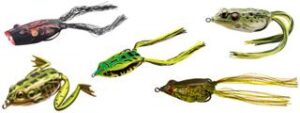
One of the hottest lures in bass fishing today is the soft plastic frog. These baits are rigged weedless, and they are fished on the surface.
They look extremely lifelike as they ripple across these likely bass hangouts.
They trigger a bass’s urge to attack helpless prey.
Following are tips for fishing soft plastic frogs.
– Experiment with different frog colors to see if the bass have a preference.
– Try different retrieve speeds to see which the bass likes best.
Reel a frog quickly across the surface. Also, try a medium-speed retrieve and a slow, start/stop retrieve.
– When a bass engulfs a soft plastic frog, don’t set the hook until you feel the weight of the fish pulling your rod tip down. Then set the hook forcefully and try to move the fish from the cover.
Hula Poppers
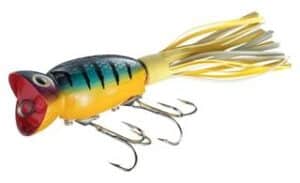
After you cast it out, sweep the rod to make the bait rush forward.
This forward motion causes the cupped mouth to create a “popping” noise in the water. It also leaves a small bubble trail behind it as it makes its way along the surface.
Jerkbaits
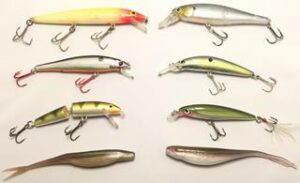
A jerk bait is a reaction bait pattern that aims to imitate a wounded or even a dying baitfish.
For clearer water, you’ll want a more natural color. You’ll want to imitate the natural colors of a baitfish.
Translucent patterns or any baitfish colors are your best option for clear water.
When fishing more stained water, you’ll want a pattern that is brighter and less natural.
Chartreuse, pearl white, or a morning dawn pattern will do the job in dirtier water.
Running depth is also another varying feature of jerk baits. There are shallow jerk baits (0-3 feet), medium-depth (4-7 feet), or deep-diving (7 feet or more).
How to Work a Jerkbait
In jerk bait fishing the action is created by the angler. This is done by jerking your rod as you reel the lure in. Every time you jerk the rod, the bait will shoot off in different directions.
This imitates the last swimming strides of a dying baitfish, which is a dinner bell for bass.
The bait will wobble if reeled in a straight retrieve but it’s the jerking of the rod tip that makes these lures unique.
Here is a little step-by-step process that gives the jerk bait an explosive and irresistible action:
After casting out, have the tip of your rod pointing at the bait.
Begin moving the rod downward, this can be diagonally or straight downward.
Once twitched, let the rod recoil back into the starting position.
Wind up the slack, and begin the moving process again.
The ‘jerking’ action can vary in direction and speed. This can be determined by water temperature or just the general activity of the fish.
Jitterbug
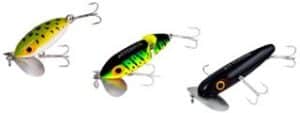
The jitterbug does not pop. The unique lip design will provide all the action for you.
The textbook way to fish a Jitterbug is to simply cast it out and reel it in a slow and steady retrieve.
There is only a small range of speeds you can reel it because if you reel it too fast or too slow you won’t engage the wobbling action.
When retrieved, the Jitterbug should wobble side to side.
You can vary the speed of the retrieve a bit, and a steady retrieve like this will often produce fish. The rhythm of the lure wobbling back and forth causes a lot of commotion.
An even more effective method for Jitterbug fishing is to use the stop-and-go technique. Retrieve the jitterbug for a few seconds, and pause anywhere from a few seconds to fifteen seconds.
After the lure lands with a plop, let it sit for a good twenty seconds before retrieving it. Many times a fish will strike before you even start reeling it back in!
What color lure to use?
Since Jitterbugs are most effective at night, dawn, and dusk, having a black jitterbug in your box is a must.
Marabou Crappie Jigs
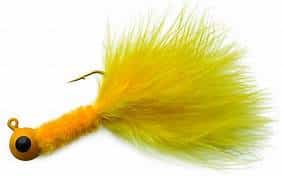
The best Marabou Jig for crappie is a 1/16 oz jig in brown or chartreuse.
Going with something brighter (like chartreuse) is going to perform much better in dirty water.
Best Marabou Jig For Bass
The best Marabou Jig for bass is a 1/8 oz jig in black or white.
If there are a lot of crawfish where you’re at, you might want to try red.
How To Fish A Marabou Jig
There are several different ways you can fish a Marabou Jig and they all work.
Method 1: Cast and retrieve.
Method 2: All you have to do is cast it out as far as you can, let the jig sink to the bottom, lift your rod tip, let the jig sink back down, and repeat.
Ned Rigs
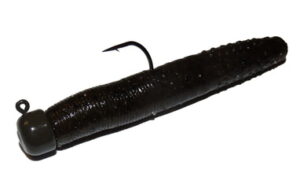
Dynamite spots to fish ned rigs are around points, bluff banks, boat docks, and anywhere bass tend to hang out.
The worms used with Ned Rigs are usually short stick baits, typically between two and a half and four inches long.
One of the most popular ways to fish a Ned Rig is to cast it out and simply let it sink to the bottom.
Once the bait is sitting on the bottom, just slowly raise the rod tip to cause the bait to drag along the bottom.
When they are at rest on the bottom the tail end of the bait will float up.
Watch as it falls for the telltale ‘tick’ that indicates a fish.
When fishing the Ned rig, start reeling once you feel the bite.
Paddletail Jigs
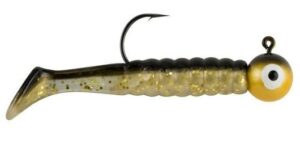
The main purpose of paddle tail swimbaits is to mimic a baitfish swimming through the water, a very natural presentation.
White is an excellent natural shad color that fish are almost always willing to eat.
If white is too boring for you, go with a half-white, half-gold swimbait as many types of baitfish have this in their colorations.
How To Work Paddle Tail Swimbaits
You can slow roll the bait on the bottom, pop the bait as you reel it in, and even burn the bait across the top of the water in shallow areas.
A paddle tail swimbait is very versatile but works best when slowly rolled near the bottom.
Pistol Pete Flies
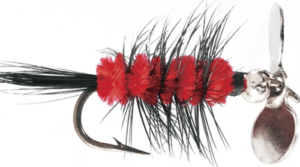
Pistol Petes are one of the hottest flies around.
Whether you fish Pistol Petes with a spinning rod or fly rod, or by trolling them behind a boat, you will find Pistol Petes to be consistent fish-getters.
Pistol Petes are very effective for trout, salmon, steelhead, pike, bass, crappie, walleye, and other freshwater gamefish.
PISTOL PETES are proven to be consistent producers.
The secret of the Pistol Pete is the small propeller on the front of the fly, which creates action and sound that excites fish into striking even when they are not in a feeding period.
The propeller on PISTOL PETES attracts the fish’s attention and triggers strikes because it combines both “action” and “sound.”
Many anglers fish PISTOL PETES with a light spinning rod using a “fly and bubble” setup. This is a particularly effective way to fish.
PISTOL PETES in lakes using a slow, stop, and go, retrieve.
Many anglers also have had success trolling PISTOL PETES behind a boat.
Placing a small split shot about six inches in front of the PISTOL PETE helps get the fly down.
The pitch of the propeller can be changed to allow it to spin at the speed you desire. Experiment, you may find a fast propeller that works better for you.
PISTOL PETES are available in over 50 different fly patterns and sizes.
Poppers
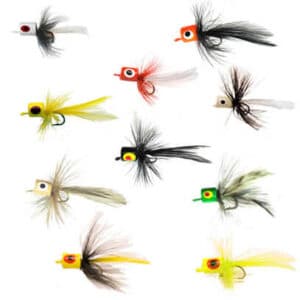
Because sunfish aren’t inherently spooky but rather curious, the small splash of a bobber might push fish out a few feet initially, but usually, they’ll come back to the commotion, looking for an easy meal.
Start with natural colors like olive green, beige, or ash to best mimic aquatic insect life.
Consider a high-contrast color if bites are more slurping than splashing; white, black, or chartreuse stand out on most water surfaces and it’s easy to tell when they disappear.
Spinnerbaits
Colorado Blade
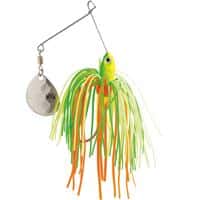
These blades are almost perfectly round. Colorado blades produce the most vibration in the water. The shape of these blades also mimics the shape of panfish.
Indiana Blade
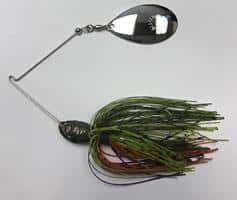
Indiana blades are perfect in warming or cooler water. There is also a great option for slightly stained water where there are several feet of visibility.
Willow Blade
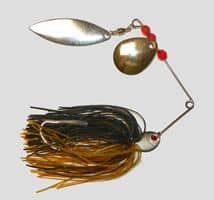
The blades are longer and have a slender shape. They kick off the least amount of vibration. They are the perfect choice for clear water situations.
The shape allows the bait to move through the water faster and prevents the fish from getting a good look at it as it cruises past.
· Gold blades are a great option in low-light conditions.
· Silver blades will perform best in clearer water and sunny conditions.
· Single-bladed baits should be used when a smaller presentation is needed.
· Double-bladed baits have two of the same style blades.
· Tandem is when you have two different styles of blades on the bait and it is the most versatile.
Cast it out and retrieve it back. While this very basic approach can catch fish.
The Basics of How to Fish a Spinnerbait
On a standard retrieve the blades spin and the wire vibrates, which causes the individual strands of the skirt to wiggle a little bit.
Varying Retrieve Speed
When reeling the spinnerbait back turn the reel handle quickly two or three times. Afterward, return to standard reeling speed.
This should be done every five to ten feet or whenever the spinnerbait is in the first third of a spot the bass should be in.
Spoons
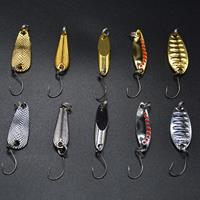
Spoons are a simple design, an oblong shape, concave on one side that catches water producing a wobble and light-reflecting flash imitating a fleeing or crippled baitfish.
The action of a spoon is based on its shape and thickness.
A long spoon will display a wider side-to-side wobble than a shorter spoon.
A deep concave spoon will also produce a wider wobble than a flatter spoon.
When casting a spoon the speed is critical for success, if fished too slowly or too fast the spoon will not wobble properly.
Spoon Colors
For casting spoons in clear or slightly stained water the classic colors of red and white with nickel back, black and white with nickel back, and combinations of nickel/silver – gold/brass are your best bet.
On stained or darker water use, fire tiger with brass back or orange/yellow and nickel combinations.
Umbrella Rigs
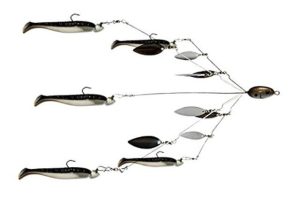
Umbrella rigs essentially allow an angler to cast a school of baits on wire arms.
What is an umbrella rig?
Typically, rigs have four outer wires and one center wire that is a bit longer than the rest.
The trick is to attach a swimbait to the end of each wire, thus creating the “school of baitfish” effect when reeled through the water column.
Depending on different state laws and regulations, anglers will use as many hooked swimbaits as they can and thread hookless “dummy” baits on the remaining arms.
To prevent the rig from spinning, use heavier jig heads on the bottom wires, and lighter (or weightless) jig heads on the top.
A good starting place for a 5-wire rig is to use ¼ ounce jig heads on the two bottom and center wires, and 1/8 or 3/16 ounce jig heads on the top two wires.
Often, rigs will be designed to carry extra “dummy” baits without hooks that keep the baits with hooks in prime position for the fish to eat.
The most popular baits are usually 3- and 4-inch swimbaits on fairly light jig heads.
An umbrella rig can be fished at a fairly broad range of depths – from right near the bottom to the upper half of the water column.
One constant on umbrella rigs is the importance of creating one or two baits that are targets for the bass to strike. Often, using a larger bait in the center is a key factor.
If you’re limited in the number of hooks you can use, you typically want the baits with hooks to be on the bottom and the back of the rig not on the top.
How to fish umbrella rigs
Simply casting and retrieving is often the name of the game with an umbrella rig.
Where to fish umbrella rigs
You can run an umbrella rig parallel to a dock, around bridge pilings, or out on a break in the main lake.
Umbrella rigs are best used in fairly clear water. They certainly could catch fish in muddy water, but the clear waters have proven to be ideal scenarios more times than not.
The best equipment for fishing umbrella rigs
For baits, almost any swimbait will work, and small fluke-style baits can be good too.
The best swimbait heads for umbrella rigs are usually light, around 1/8- or 1/16-ounce, but they should have a stout enough hook to match the tackle you’re using.
Whopper Plopper
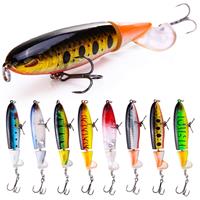
The Whopper Plopper is a topwater prop bait.
The most effective way to fish them is simply reeling them in a straight retrieve the way you would fish any prop bait.
The motion of the bait gliding across the surface is what causes the tail to spin and make the “plopping” noise.
Whopper Plopper Sizes
There are five sizes and more colors.
You might be wondering what the model numbers mean.
That is the length of the bait in millimeters, and it’s printed on the belly of every whopper plopper to avoid confusion.
Fishing Whopper Ploppers
Whopper ploppers are one of the easiest lures to fish for two reasons.
One, the most effective way to fish them is simply reeling them in a straight retrieve the way you would fish any prop bait.
The motion of the bait gliding across the surface is what causes the tail to spin and make the “plopping” noise.
If you can’t hear the sound the bait is making then you are not reeling at the optimal speed.
The speed that makes the bait produce the loudest sound is the retrieve speed you want to hit.


