Avoid Alzheimer’s Disease
Alzheimer’s disease is a neurodegenerative disorder that shows progressive dementia, and it is the fourth most common cause of death.
There are clear pathological hallmarks of the disease, mainly in the form of plaques and tangles.
Plaques are abnormal clusters and fragments of protein that build up between nerve cells.
Dying nerve cells contain tangles, which are made up of another protein.
These plaques and tangles might be the reason for cell death and tissue loss in the Alzheimer’s brain.
Our brain has three major parts: the cerebrum, the cerebellum, and the brain stem.
The cerebrum is the major part of our brain. Its main function is in the areas of remembering, problem solving, thinking, feeling, and controlling our movement.
The cerebellum is located at the back of our head, under the cerebrum, and it controls our coordination and balance.
The brain stem is located beneath the cerebrum in front of the cerebellum.
It connects the brain to the spinal cord and controls automatic functions, such as breathing, digestion, heart rate, and blood pressure.
The brain is nourished by networks of blood vessels comprised of arteries, veins, and capillaries. The arteries carry blood to fuel our brain with each heartbeat.
The unique outer layer of our brain is called the cortex, which is quite clearly mapped according to specific functions.
Among the major functions we can notice our sight, sound and smell, thoughts, problem solving, memory storing and retrieving, and controlling certain movements.
Our brain is divided into two hemispheres; the left half controls the right body’s side and the right half controls the left side.
Alzheimer’s disease is responsible for the destruction of neurons and the disruption of the activity of neurotransmitters.
We also know that Alzheimer’s disease leads to nerve cell death and tissue loss throughout the brain.
Over time, the brain shrinks dramatically, affecting nearly all its functions.
What causes Alzheimer’s?
It is assumed that the cause is a complex sequence of events comprising genetic, environmental, and lifestyle factors.
We do not understand the exact cause or the contributions of those factors, and it varies from case to case.
What diagnostic tools are available?
One of the popular examinations is using Magnetic Resonance Imaging (MRI), mainly because it enables the visualization of the brain structures in three dimensions.
Computed Tomography (CT) is another visualization tool used for the diagnosis and evaluation of dementia, especially for cases at early stages.
The Positron Emission Tomography (PET) scan shows brain activity in real-time associated with functions such as reading, hearing, thinking, and saying words.
What parts of the brain are affected?
Alzheimer’s eventually affects most parts of the brain. However, each person is affected differently as the disease progresses.
The main brain regions affected by Alzheimer’s are the frontal, temporal, and parietal lobes.
The frontal lobe is located at the front of the brain and controls a range of functions such as intelligence, making decisions, solving problems, and other mental and social functions.
The temporal lobe is located at both temples and ears, and they are responsible for long-term and short-term memories.
Speech ability is located behind the temporal lobe at the parietal lobe. This region is also responsible for the visual system and enables visual analysis and stimuli.
Damage to this area may cause abnormal speech and visual problems.
Alzheimer’s first affects the hippocampus, which is located in the medial temporal lobe of the brain.
It is the area of the brain in which new memories are formed. It then moves to other areas affecting different functions, such as reasoning or emotions.
The cerebellum and the brain stem are the last areas of the brain to be affected.
This is when we lose control of basic functions such as breathing, heart rate, and blood pressure.
This is Alzheimer’s final stage, leading to death.
What do we know about the statistics of Alzheimer’s disease?
More than 5 million Americans have Alzheimer’s.
The number of Alzheimer’s cases doubles every five years after age 65, and the risk is about 50 percent after age 85.
About 10 percent of all Alzheimer’s cases occur at age 30.
More women than men develop Alzheimer’s disease.
Alzheimer’s disease is the sixth-leading cause of death in the United States.
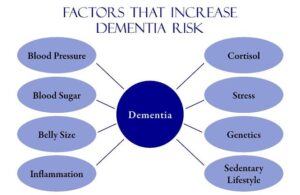
High glucose levels can double our lifetime risk of developing Alzheimer’s.
Stroke and Alzheimer’s share many risk factors, and the likelihood of dementia is doubled after a stroke.
What are the risk factors?
There are uncontrollable risk factors, such as genetics and aging, and risk factors that we may control, such as our life habits.
The known and established risk factors for Alzheimer’s disease are genetics and aging, both uncontrollable.
What can we do to reduce the risk?
Maintaining good blood flow – Physical exercise is essential for maintaining good blood flow to the brain.
Low cholesterol diet – A low-fat, low-cholesterol diet with dark vegetables and fruits, which contain antioxidants, may help protect brain cells.
We know that high cholesterol may contribute to stroke and brain cell damage.
Reducing stress – Social activity not only makes physical and mental activity more enjoyable, but it can also reduce stress levels, which helps maintain healthy connections among brain cells.
Sleeping well – Nightly sleep deprivation may slow our thinking and affect our mood.
Stop smoking – Smoking will increase the risk factor and may reduce the age of Alzheimer’s onset by seven years.
Smoking has an extremely harmful effect on the heart, lungs, and vascular system, including the blood vessels in the brain.
Stop drinking alcohol – Brain changes from alcohol abuse can only be reversed in their early stages.
Brain cells stimulation- Mentally stimulating activities such as crossword puzzles, reading, learning, and interactive computer games may create new nerve cells and at the same time strengthen brain cells and the connections between them.
When stress is continuous and unrelenting, this is the point at which it starts to be harmful. It can hurt both physically and psychologically.
There is a link between stress and life expectancy.
Future proposed studies and methodologies
We should concentrate on detecting the specific location where Alzheimer’s disease may begin. This is probably a specific vulnerable area of the brain, from which the damage is spread to other areas of the brain.
Future gene research may lead to a better understanding of the mechanisms of the disease, which hopefully will lead to the appropriate prevention and treatment.
A promising research area is using stem cells for treating Alzheimer’s. There are many ways to approach this option.
Among the various possibilities we may suggest to re-grow diseased parts, to heal rather than replace neurons, or to use stem cells as drug delivery agents.
Adult stem cells have a positive effect on those who already have Alzheimer’s disease. In the future, they may even prevent the disease.