Origin of Alzheimer’s Disease
Alzheimer’s, also known as Senile Dementia of Alzheimer’s Disease, is an incurable, degenerative, and terminal illness that affects about 1 in every 68 people.
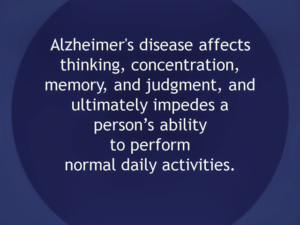
Alzheimer’s disease typically affects people at 65 years or older, however, there are rare cases of early-onset Alzheimer’s, which occurs at a much younger age.
Symptoms of Alzheimer’s are usually misdiagnosed or overlooked due to the person’s age.
What are thought to be the first symptoms of Alzheimer’s are usually the most mistaken: difficulty with memory recall, especially with recent occurrences, and the inability to form new memories.
Additional symptoms include confusion, irritability, aggression, mood swings, language breakdown, long-term memory loss, and withdrawal.
As the disease progresses, the person’s ability to function and communicate effectively diminishes, causing the person to be completely reliant on others.
This causes the person to retreat or withdraw from social interaction.
Alzheimer’s can cause a person to become disoriented, not know where they are, what they are doing, or who the people around them are.
Ultimately, Alzheimer’s can cause a very slow, painful, miserable, and lonely end to life.
Currently, scientists do not know the cause of Alzheimer’s, nor do they have a treatment for it.
The progression of the disease is so sporadic that a definitive determination on how the disease progresses cannot even be established.
Research has found that Alzheimer’s is a degeneration within the brain in which plaques or tangles form from proteins.
Unfortunately, once the plaque occurs within the brain, there is no reversal, therefore subsequently causing Alzheimer’s disease.
The development of symptoms varies so severely that most cases of Alzheimer’s are misdiagnosed.
Treatments have not affected the curing or halting of the progress of this disease and have given very little symptomatic relief.
Presently, there has been nothing proven that delays the progression of Alzheimer’s.
Lifestyle changes have been recommended to prevent the onset of Alzheimer’s however, there is no factual evidence to support this because no cause or cure has been established.
Pharmaceutical drugs, as well as mental stimulation, exercise, and a balanced diet, have all been employed to help treat and prevent the onset of Alzheimer’s.
People with Alzheimer’s need constant care and supervision until a breakthrough can determine how to manage this disease.