Stages Of Alzheimer’s Vary From Person To Person
No two people are alike and that is true of patients experiencing the stages of Alzheimer’s.
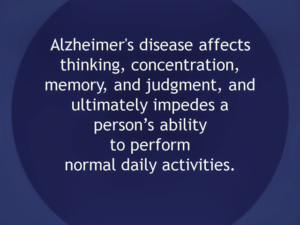
Alzheimer’s is a form of dementia that robs one of his or her ability to reason, remember, and function by slowly killing brain cells.
Some patients may skip some stages of Alzheimer’s or some may be in one stage for many years.
Alzheimer’s patients live an average of three to 20 years after they are diagnosed.
In the first stages of Alzheimer’s, the patient shows no symptoms. They are functioning normally and are completing everyday activities.
In the second stage of Alzheimer’s, the patient may begin to have memory lapses.
It is often not until the third stage of Alzheimer’s that the symptoms become noticeable. Unlike the previous two stages of Alzheimer’s, patients can no longer hide their difficulties.
During the third stage, patients forget the names of family or close friends, begin to lose their ability to plan and organize, and often misplace objects.
Family, friends, and co-workers will notice a decline in their work and perhaps in their social skills.
In the fourth stage of Alzheimer’s, patients are beginning to forget current events.
Simple math becomes a challenge. Bills may go unpaid, housework may be neglected. At this stage of Alzheimer’s patients may withdraw from social settings they once enjoyed.
In the fifth of the stages of Alzheimer’s, patients are more challenged by everyday tasks.
Even though the stages of Alzheimer’s and their symptoms vary from person to person, by the sixth stage there is usually a noticeable decline in the patient.
Many times during this stage of Alzheimer’s the patient is not aware of what is happening around them. They need help doing everything.
The patient may have delusions or hallucinations and forget the names of those around them.
It is in the very last stages of Alzheimer’s that the disease is most brutal. In the seventh stage, the patient is usually totally dependent on someone else.
In addition to all the changes in the previous stages of Alzheimer’s, the patient may lose their ability to walk, sit up, or even hold their head up.
They need to be fed and helped to go to the bathroom and there is usually general incontinence. Their speech is often unrecognizable.
A physician is the only person who can diagnose Alzheimer’s disease.
The family physician can also offer advice and refer caregivers and private nurses to Alzheimer’s patients.
The Alzheimer’s Association also provides a wealth of information on the stages of Alzheimer’s.