Alzheimer’s Stages
So what are the stages of Alzheimer’s disease? What can be expected with this distressing and devastating disease?
There are several different classification systems for the stages of Alzheimer’s.
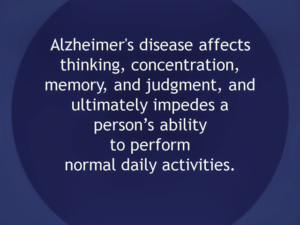
The stages of Alzheimer’s are complicated even more by the fact that the disease doesn’t progress at the same rate in everyone, and that different people may be showing different symptoms.
A sufferer could be in stage one and show some of the signs of stage two.
The classifications used by many medical practitioners are based on cognitive and functional impairment, ranging from mild to moderate, severe, and finally, profound.
The first stage of Alzheimer’s is mild cognitive impairment. At this stage, the impairment is only noticeable by the sufferers and their families.
Sufferers will often deny that there is a problem and try to cover up their forgetfulness.
Shrinkage of the brain is occurring.
There is damage to the area where short-term memories are converted to long-term memories.
Symptoms in the first stage are often mistaken for age-related.
In stage two (moderate), the signs are becoming more apparent, but still may only be noticed by the sufferer and people they’re close to.
The sufferer can still appear to be healthy. New facts and new memories are affected more than older facts and memories.
There can be some problems with fine motor tasks, and there can be language problems such as a reduced vocabulary, though the sufferer can still communicate basic ideas adequately.
Stage three is more severe, and there is no doubt that the sufferer has problems.
There can be agitation and wandering away from home, and there must be a higher level of care for the person.
Memory problems get worse with the long-term memory becoming affected, and the sufferer can even fail to recognize close relatives. Motor problems become worse, and so does the loss of vocabulary.
There can be aggression and urinary incontinence. At some stage, the sufferer has to be moved into long-term care facilities.
In stage four of Alzheimer’s, the sufferer is approaching death.
They are completely dependent on their caregivers, they have trouble communicating, and they lose control of their minds and their bodily functions.
The sufferer’s immune system becomes quite weak, ultimately resulting in death not from Alzheimer’s itself, but from another disease, usually pneumonia.
If there is one ray of light with this terrible disease, it’s that studies show that it is possible to change the course of Alzheimer’s. You can slow down or even halt the disease.
Apart from medication, changes to diet, using supplements, and doing physical and mental exercise can all help fight and prevent Alzheimer’s.
It’s important to have an early diagnosis. The sooner treatment is started, the better the results are likely to be.
So if you suspect you have Alzheimer’s disease, don’t ignore it or go into denial. See your doctor.
It’s possible your symptoms are not the early stages of Alzheimer’s but something less serious. If you do have Alzheimer’s, start treatment.