Dementia is a non-specific illness issue. It affects areas of the brain that deal with cognition could be the ability to remember, attention span, speech, and even problem-solving.
Dementia usually occurs in older age groups. It is rare in people under age 60.
The possibility of developing dementia will increase as the person gets older.
A person usually must exhibit symptoms for about 6 months to be diagnosed.
Major Causes and Risk Factors Which are Related to Dementia:
Most types of dementia can be nonreversible (degenerative).
Nonreversible would mean the alterations in the brain that are causing the dementia are unable to cease or switched back.
Alzheimer’s disease is easily the most common type of dementia.
·Vascular dementia is a kind of dementia that may be caused by several small strokes.
·Lewy body disease is the main cause of dementia in the elderly. Individuals with this disorder have abnormal protein structures in certain regions of the brain.
The following medical ailments also can result in dementia:
·Parkinson’s disease
·Multiple sclerosis
·Huntington’s disease
· Pick’s disease
·Progressive supranuclear palsy
·Infections that can affect the human brain, such as HIV/AIDS and Lyme disease
Some reasons for dementia could be ceased or reversed if they are found quickly enough, such as:
·Brain tumors
·Changes in blood sugar, sodium, and calcium levels
·Lower vitamin B12 levels
·Normal stress hydrocephalus
·Using certain medicines, including Cimetidine and certain cholesterol-lowering medications
·Persistent excessive drinking
Certain symptoms that will help you recognize the early phases of Dementia:
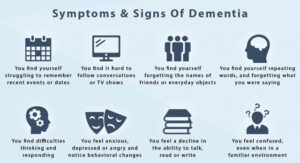
Dementia first appears to be forgetfulness. Early Dementia signs consist of difficulty with most areas of mental function, which include:
·Language issues, for instance, difficulty locating the name of common objects –
·Misplacing objects
· Losing your way on familiar routes
·Character modifications and decrease in social skills
·Losing interest in things you formerly appreciated, flat spirits
·A hard time performing tasks that take some thought, but that used to come easily, such as handling a checkbook, playing video games, and learning new details or routines
As dementia gets worse, symptoms are more noticeable and interfere with the ability to take care of oneself.
The symptoms can include:
· Failing to remember details about the latest events
· Forgetting occasions from your background, losing awareness of who you are
· Change in sleeping habits, usually getting up at nighttime
· More trouble learning or writing
· Weak judgment and loss of ability to identify a hazard
· Making use of the wrong phrase, not pronouncing words effectively, speaking in confusing lines
· Withdrawing from social contact
· Experiencing hallucinations, arguments, and aggressive behavior
· Experiencing delusions, major depression, agitation
· A hard time doing simple duties, for instance, cooking, selecting appropriate clothing, or driving a car
Numerous medicines for the treatment of Dementia are available:
Medications may be required to manage behavior issues caused by a lack of judgment, elevated impulsivity, and confusion.
Medications include various Antipsychotic medications, particular kinds of Serotonin-affecting drugs, and stimulants.
Certain medicines could be used to slow the rate at which problems worsen.
The advantage coming from these medicines is usually small, and patients and their families may not always observe a great deal of change.
Psychotherapy or group therapy usually does not help because it could cause a lot more distress.
Complications associated with Dementia:
· Mistreatment by an overstressed sitter
· Increased infections anywhere in the body
· Loss of ability to work or care for self
· Loss of the ability to communicate
· Decreased life span