The three cardinal signs of Parkinson’s disease are resting tremor, rigidity and bradykinesia. Of these, two are essential for diagnosis.
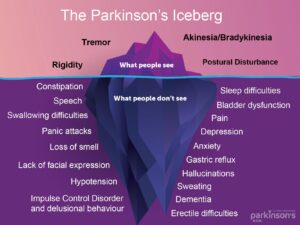
Bradykinesia is the medical term for movements that are slower than expected.
For instance, it may take you longer to stand up or button your shirt.
You also might not make automatic movements like swinging your arms while walking. It can even affect your facial expressions.
Postural instability is the fourth cardinal sign, but it occurs late, usually after 8 years of disease evolution.
– In 70% of cases, uncontrollable rhythmic gestures of the hands, head, or feet are the first symptoms and occur mainly at rest and during periods of stress.
Tremor is diminished during movements, disappears during sleep, and is enhanced by stress and fatigue. Tremor becomes less evident as the disease progresses.
– Stiffness refers to increase resistance to passive mobilization of the muscles and is more evident in the contra lateral limb voluntary movements.
– Bradykinesia refers to slowness of movement but includes decreased spontaneous movements and decreased range of motion.
Bradykinesia is visible by micrographic (small handwriting, illegible), hypomimia (decreased mimic movements), rarely blinking, and hypophonia (impaired voice).
– Postural instability refers to impaired balance and coordination. Its appearance is an important stage in the disease because it is difficult to treat, and postural instability is a common source of disability in advanced stages of disease.
– Dementia occurs late in the evolution of Parkinson’s disease and affects 15% – 30% of patients. Recent memory is impaired.
Other signs are:
– Sleep disorders
– Difficulty in swallowing
– Salivation (heavy salivation)
– Micrographic (written small, illegible)
– Hypophonia (diminished, monotonous voice) and difficulty in articulating words
– Urinary incontinence and constipation, due to alteration of bowel and bladder function
– Confusion, memory loss
– Disturbances of gait with small and shamble steps; pronounced tendency to fall through the loss of postural reflexes
– Loss of arm balance while walking
– Orthostatic hypotension
– Seborrheic dermatitis
– Changes in personality
The second neurological disorder after Alzheimer’s
In terms of frequency, Parkinson’s disease is the second neurological disease after Alzheimer’s and is due to faster degradation of neurons.
Usually symptoms appear around the age of 55 years, but there are juvenile forms of Parkinson’s. Real onset of the disease is 8-10 years before clinical signs such as progressive loss of smell, sleep or bowel disturbances appear.
Characteristic sign is the emergence of movement disorders. At the onset, they are unilateral, first in one hand, within a few years becoming bilateral.
Life expectancy over 80 years
Drugs do not cure the disease, but prolong the life expectancy of patients so that they exceed the age of 80 years. Initially, treatment consisted of a single type of drug that relieves symptoms.
As the disease progresses, the dosage will increase and will join other drugs according to symptoms and complications that give the pills.